
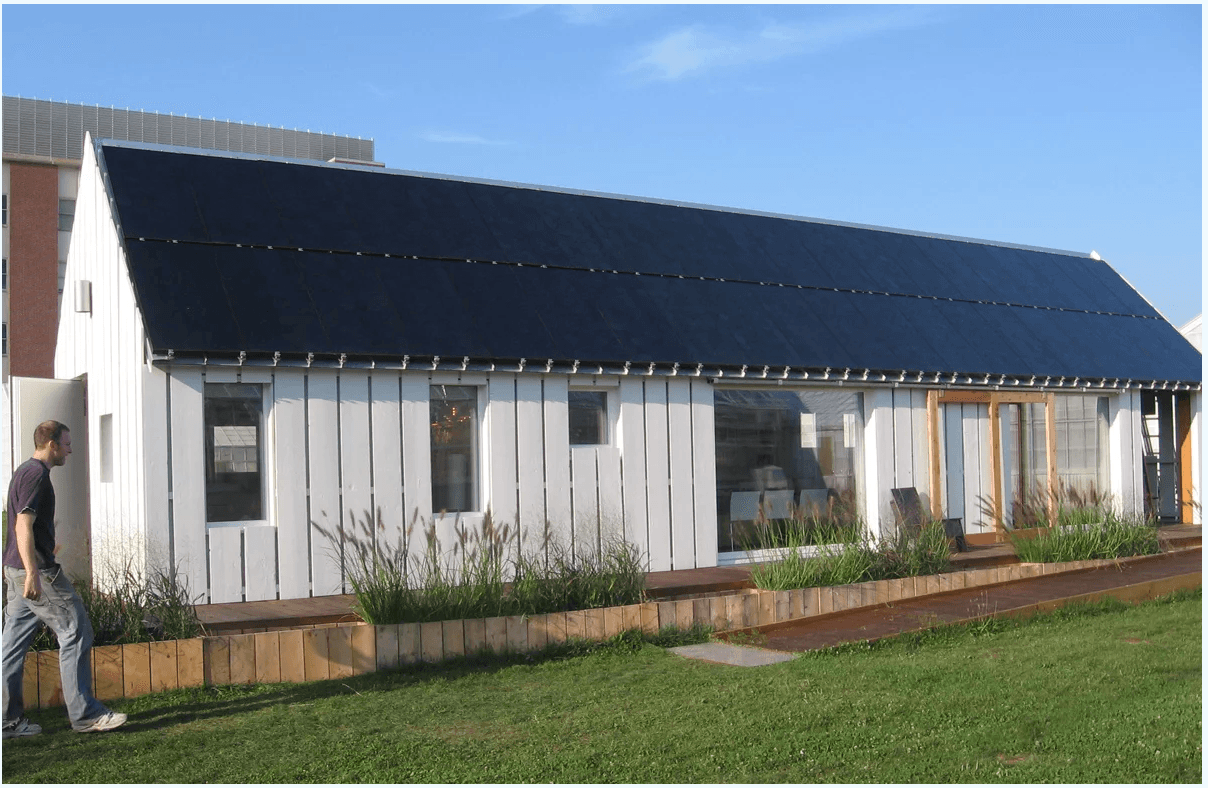
A Midwestern Evolution
The Gable Home was our 2009 Solar Decathlon entry. Inspired by the traditional gable-roofed farmhouses and barns characteristic of the Midwest, the project explored how familiar architectural forms could be paired with advanced building science and solar technologies.
The design positioned high-performance housing not as a departure from regional identity, but as an evolution of it. By marrying an iconic aesthetic with cutting-edge efficiency, the project challenged conventional assumptions about sustainable living.
Reclaimed Materials & Form
The exterior incorporated reclaimed barn wood siding and a sliding wood screen system that enhanced passive solar control. This approach not only paid homage to regional vernacular architecture but also served a crucial functional role in regulating the home's thermal load.
Advanced Building Science
A laminated bamboo structural frame, nearly 12 inches of high-performance insulation, and strategically positioned glazing significantly reduced heating and cooling loads.
A 9.1 kW photovoltaic array generated up to four times the home’s operational demand. Through the combined impact of envelope efficiency and on-site energy generation, the Gable Home achieved approximately 90% lower energy consumption than conventional residential construction.
Scale, Rigor & Impact
Developed by more than 200 students and collaborators, the project illustrated the scale and technical rigor of the Illinois Solar Decathlon program. It stands as a testament to what interdisciplinary teams can achieve when combining ambition with deep research.
The final result reinforced the viability of regionally grounded, performance-oriented design—proving that sustainable homes can deeply respect their local heritage.