
Disaster-Responsive Design
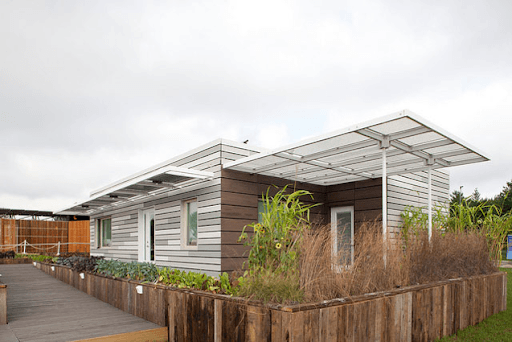
Re_Home was our entry into the 2011 Solar Decathlon. Developed during a year that recorded 1,718 tornadoes in the United States—nearly double the historical annual average—the project responded to the need for rapidly deployable, disaster-responsive housing in the Midwest.
The prototype was conceived as a modular dwelling capable of transitioning from trailer transport to a fully assembled building frame in approximately three hours. Designed as a one- to two-bedroom, one-bath residence with full handicap accessibility and 36-inch doorways, Re_Home balanced emergency functionality with long-term residential livability.
Modular Construction
The structure consisted of two primary modules constructed in partnership with Illinois-based manufacturer Homeway Homes. A core module housed the kitchen, bathroom, and mechanical systems, while the secondary module contained living and flexible areas.
Exterior finishes included painted cedar siding, Resysta panels composed of recycled rice husks and natural binders, and reclaimed wood decking, merging rapid manufacturing with sustainable material choices.
Envelope & Energy Systems
The building envelope incorporated spray foam insulation (R-60 roof and floor, R-45 walls) and triple-pane, argon-filled low-emissivity windows with a U-value of 0.18. Mechanical systems included a hybrid heat pump water heater and a CERV (Conditioning Energy Recovery Ventilator) unit to support high-efficiency ventilation and indoor air quality.
The photovoltaic system combined a 5.5 kW SunPower array and a 1.17 kW bifacial Sanyo array, totaling approximately 7.7 kW of installed capacity. Average daily energy consumption measured 18.4 kWh, with appliances and HVAC representing the largest loads.
Competition Success & Impact
Re_Home placed 7th overall among 20 international teams and performed strongly in both judged and measured contests, earning high placements in Market Appeal, Affordability, Appliances, and Hot Water.
The project demonstrated how modular construction, envelope performance, and resilience strategies could be synthesized into a practical housing model for the Midwest, proving that emergency housing can evolve into permanent, net-zero homes.